
The toss is ten minutes away, the pitch looks greener than expected, and the sportsbook you planned to use will not load.
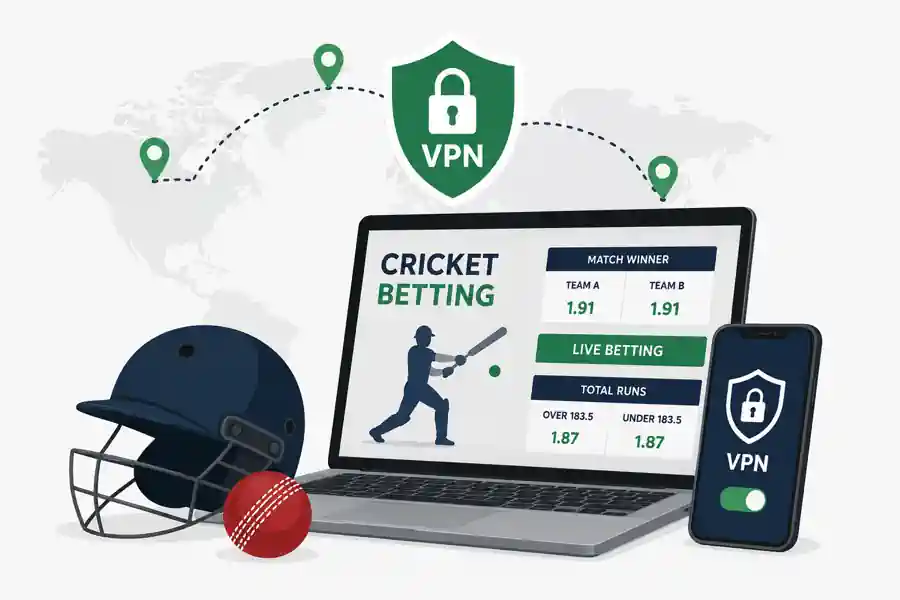
This is where many cricket bettors reach for a VPN. It can restore access, protect browsing on public networks, and sometimes provide access to a wider choice of sportsbooks. It can also create a location mismatch that gets noticed when you withdraw.
Opening the website is the easy part. The real test is whether the sportsbook permits VPN use, accepts your bets, and processes the withdrawal without suddenly discovering a problem with your location.
Why Bettors Use VPNs
Cricket is global, while sportsbook coverage remains heavily regional.
A UK bookmaker may offer detailed markets on county cricket and The Hundred. India-facing platforms tend to focus on the IPL, international matches, player props, and regional competitions. Other operators barely move beyond match winner, total runs, and top batter.
A virtual private network encrypts your connection and replaces the IP address visible to websites with the address of the VPN server.
Cricket bettors usually use VPNs to:
- Access an existing sportsbook while travelling
- Reach cricket competitions unavailable on local books
- Protect their connection on hotel or public Wi-Fi
- Bypass basic ISP-level website blocks
- Compare odds across more bookmakers
- Access crypto sportsbooks with fewer banking restrictions
A VPN does not change gambling law or override the sportsbook’s terms. If the operator excludes your country, connecting through another location may still breach its rules.
The fact that a site accepted your deposit will not help much if it rejects your withdrawal.
VPN-Friendly and VPN-Tolerated Are VERY Different
Sportsbooks generally fall into three categories.
A VPN-friendly sportsbook clearly allows VPN use and continues working during registration, betting, and withdrawals.
A VPN-tolerated sportsbook does not clearly approve VPNs, but access works during normal use. This remains a grey area. The operator may ignore the VPN while you are losing and become more interested after a large win.
A VPN-forbidden sportsbook explicitly bans proxies or location-masking services. Using one may lead to additional verification, account restrictions, cancelled bets, or voided winnings.
This difference is more important than a generic “works with VPN” label. Loading a sportsbook homepage through a VPN takes about thirty seconds and proves very little.
VPNCasinos tests access, sportsbook functionality, KYC timing, withdrawal behaviour, and operator terms when comparing VPN sports betting sites. A sportsbook should only count as VPN-friendly when players can bet and withdraw consistently while connected.
A bookmaker that accepts your IPL bets and freezes the account at cashout was never particularly friendly.
Live Betting Makes Connection Quality Matter
VPN speed may not matter much when placing a Test match bet the night before play. It becomes important during an IPL chase or a tight final over.
Live cricket odds can change after every delivery. Wickets, boundaries, reviews, injuries, bowling changes, and shifts in the required run rate can suspend or reprice a market within seconds.
Every VPN adds another network step between your device and the sportsbook. A nearby, lightly loaded server may add very little delay. A distant server can leave you staring at odds that are already gone.
For live cricket betting, look for:
- A server reasonably close to your real location
- Low ping and stable routing
- A paid provider with reliable infrastructure
- WebRTC and DNS leak protection
- An automatic kill switch
- A server location you can use consistently
Test the connection before the match begins. Streaming video smoothly does not guarantee that an in-play betting interface will update quickly enough. Avoid changing server countries during the same session.
Keep Your Location Details Consistent
Sportsbooks do not rely entirely on IP addresses.
Operators may also examine browser language, device information, GPS permissions, time zone, cookies, WebRTC data, payment history, previous logins, and account documents. Mobile apps may use device-level location services that a standard VPN cannot hide.
Problems begin when these signals contradict each other.
Registering through Canada, depositing from an Indian-linked account, logging in through Germany, and submitting a Pakistani address during KYC creates several versions of the same customer.
Use one stable location where possible. Avoid changing devices, browsers, wallets, and server countries during a betting period. Never create several accounts to claim regional promotions. Multi-accounting can close an account even where VPN use itself is tolerated.
Cricket Market Depth Still Matters
A sportsbook may work perfectly with a VPN and still offer poor cricket betting.
Useful cricket coverage should extend beyond the match winner. Depending on the competition, stronger operators may offer:
- Player runs and wickets
- Top batter or bowler
- Sixes and fours
- Powerplay totals
- Opening partnership markets
- Fall of the next wicket
- Innings totals
- Method of dismissal
- Session betting
- Live run lines
Odds are equally important. A wider choice of bookmakers allows bettors to compare prices, although the advantage disappears when the additional sportsbooks have poor margins.
A two-way market priced at 1.80 on both sides carries a much larger bookmaker margin than the same market at 1.91. That difference looks small on one wager. Across a full IPL or PSL season, it becomes expensive.
Access alone has little value when the sportsbook offers weak prices, low limits, or unreliable withdrawals.
Check KYC Rules Before Depositing
“No KYC” often means no documents at registration.
The sportsbook may still request identification at the first withdrawal, after a large win, when an anti-money-laundering trigger is reached, or when account information conflicts with the VPN location.
Common verification models include:
- No KYC during normal account use
- Light KYC above a stated withdrawal threshold
- Standard KYC at the first withdrawal
- Hard KYC before betting
- Ambush KYC after the site advertised anonymous play
Ambush KYC is the worst version. The player only discovers the verification rules after depositing and winning.
Search the terms for “VPN,” “proxy,” “restricted jurisdiction,” “geolocation,” “verification,” and “source of funds.” Clear thresholds are preferable to vague clauses allowing the operator to request documents whenever it chooses. Take screenshots of important terms before depositing.
Make a Small Withdrawal Test
Start with a deposit you can afford to lose. Place a few ordinary bets and request a partial withdrawal before building a larger balance.
Check:
- How long approval takes
- Whether new KYC requirements appear
- Whether the VPN causes an account review
- Whether support explains delays properly
- Which withdrawal limits and fees apply
A successful small withdrawal does not guarantee that a large cashout will be painless. It exposes obvious problems before your balance becomes worth fighting over.
Be Careful in Restricted Markets
Cricket’s biggest audiences include countries with complicated gambling rules and payment restrictions.
India is the clearest example. National regulation, state laws, ISP blocking, banking controls, taxation, and offshore operators overlap in ways that make simple answers unreliable. Reuters has covered India’s tightening approach to money-based online gaming, but the practical risk still depends on the product, location, and current rules.
A VPN may open a blocked sportsbook. It does not legalize the bet or guarantee that the operator will accept your documents.
Check local law, the sportsbook’s accepted-country list, and its VPN policy before depositing. The toss can surprise you. The withdrawal terms should not.